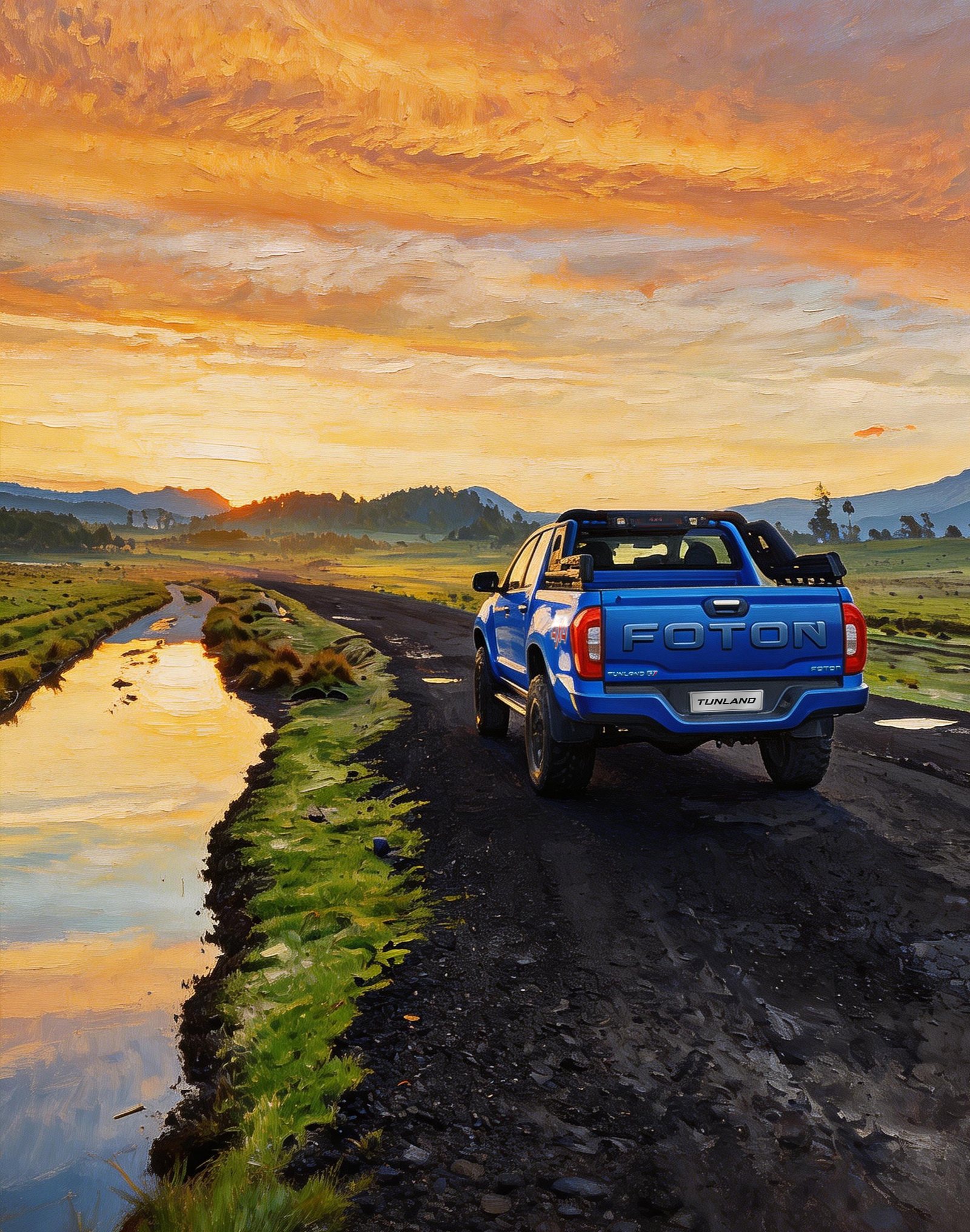
The Tunland G7 is the volume-selling pickup of the range, and most of what makes it commercially useful comes from the platform underneath it. FOTON’s own overseas product introduction sets the figures out clearly, so here they are without the marketing.
Three platforms, three jobs
FOTON builds exported pickups on three platforms. The P2 platform is the tool category — the older Tunland S and E, now being phased out. The P3 platform is the multifunctional and passenger category, and it is where the current range sits: Tunland G7, Tunland V, Tunland G9, the V7 and V9 hybrids, and the eTUNLAND electric pickup. The P4 platform is the larger, passenger-focused pickup and is a later product.
That matters to a dealer because P3 is the platform with the volume behind it — parts commonality across G7, V and G9 is a direct after-sales advantage.
The G7 in numbers
- Body: 5,340 × 1,940 × 1,870 mm (1,880 mm for some variants), double or single cab.
- Cargo box: double cab 1,520 × 1,580 × 440 mm; single cab 2,315 × 1,580 × 440 mm — the long-bed version carries a full metre more load length.
- Wheelbase: 3,110 mm, with 955 mm front and 1,275 mm rear overhang.
- Ground clearance: 210 mm, with a 28° approach and 19° departure angle.
- Drive: 4×2 or 4×4, diesel, 120 kW and 415 N·m.
- Wheels: 16-inch on 245/70R16, 17-inch on 265/65R17, 18-inch on 265/60R18.
Why 1,940 mm body width is the number to notice
It is the widest in its class, and width is the dimension that decides whether three adults fit in the back of a double cab on a working day. For a fleet buyer choosing between a workhorse and a crew vehicle, that single figure often settles the decision before payload is even discussed.
Container maths
The G7 is one of the models that loads three units per 40′ High Cube — with the single cab and the eTUNLAND. The V, G9 and hybrid load two. On a 20-unit order that is seven containers instead of ten, which is why it is the model we usually recommend first unless the specification genuinely calls for something else.