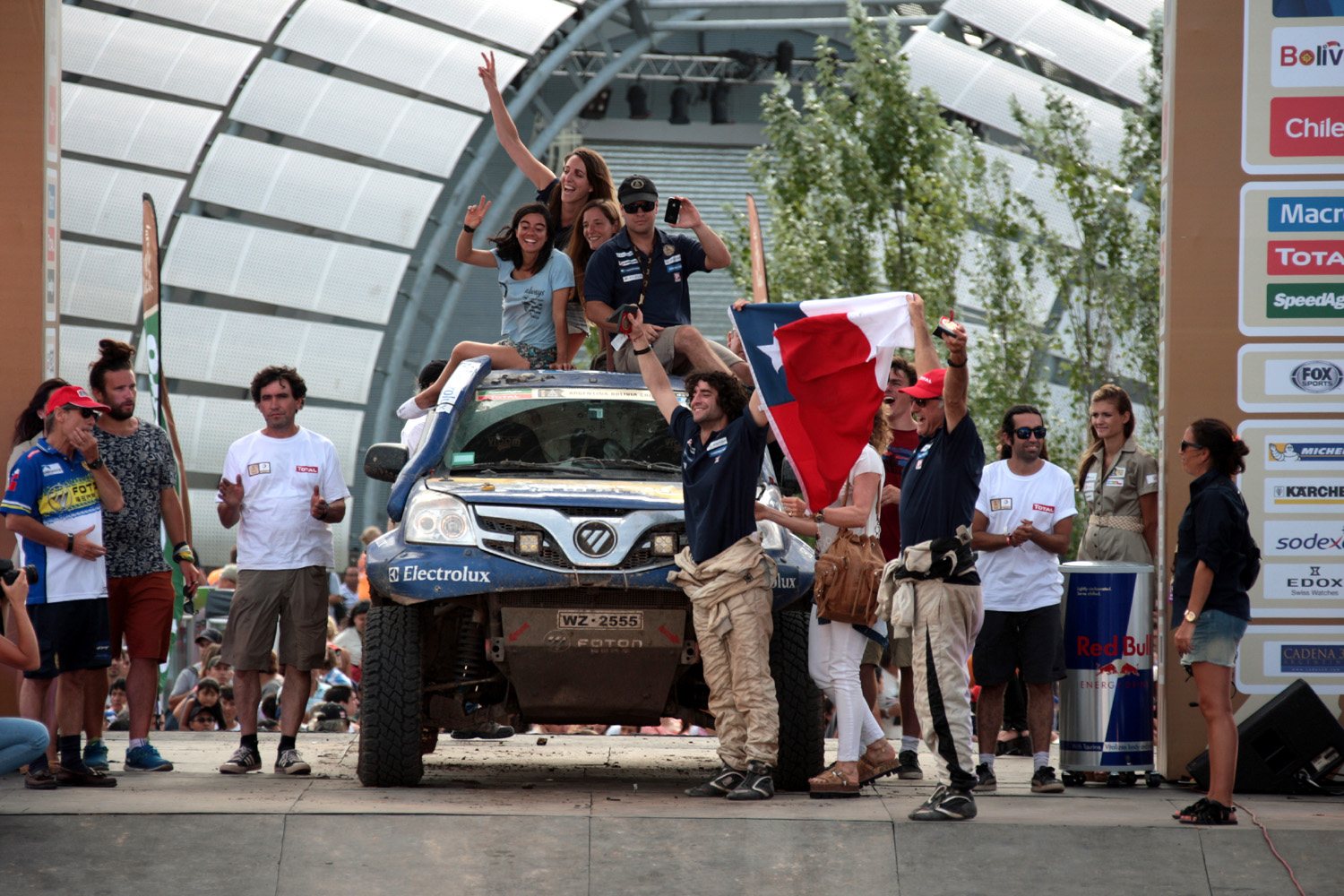
Heritage: this covers the 2014, 2015 and 2016 Dakar campaigns, not a new event.
Before the current generation of Tunland reached the export markets it ships to today, FOTON took the pickup rallying — and specifically to the Dakar, in three consecutive editions: 2014, 2015 and 2016. The photograph above is the 2015 finish-line celebration.
What the Dakar actually tests
The Dakar is not a circuit race. It is two weeks of dunes, rock, riverbed and altitude, with stages that run longer than a working day and vehicles that have to be repaired in the desert overnight. For a manufacturer, the value is not the trophy: it is that a fortnight of that environment finds the weaknesses that a decade of road testing does not — cooling under sustained load, chassis fatigue, suspension travel limits, electrical durability in dust.
A pickup that has completed Dakar stages is a pickup whose cooling and chassis architecture have been taken past the design envelope deliberately, in public, with the failure mode recorded.
Why this still matters to an importer in 2026
The vehicles are different now — the current range is the P3-platform G7, V, V9 and G9, plus the eTUNLAND and the 48V hybrids — but the engineering culture that went rallying is the same one that has to homologate a truck for your market. When a dealer asks whether the product is built to survive a working life on bad roads, a Dakar campaign is a more useful answer than a warranty clause.
It is also, frankly, good showroom material: it is visual, it is verifiable, and it is about the vehicle rather than the advertising budget.
The current range
57 orderable export configurations across six model lines, left- or right-hand drive built at the factory to order, homologated from Euro 2 through to Euro VI depending on the destination. Three units per 40′HQ for the G7, single cab and eTUNLAND; two for the V, G9 and hybrid.